Friday, September 4, 2026
Used EV Resale In India: Nobody Can Price The Battery
A three-year-old Nexon EV comes up on a used-car listing. One owner, full service history, photographed in good light. What the listing does not say, because nobody in India requires it to, is how much of the battery is left. The seller does not know. Neither does the dealer, and the bank lending against it certainly doesn't. The price sits there anyway, and somebody is going to pay it.
Why It Matters
The used market is where an electric car finally gets judged. First owners buy on running cost and a subsidy. Second owners buy on risk, and the largest risk in an EV is a component that degrades quietly, invisibly and expensively. Petrol cars gave everyone a shared vocabulary for that. Compression. Oil burn. A timing belt due at a known kilometre figure, printed in the manual. Batteries have no equivalent that anyone in this country agrees on, and the industry has been perfectly comfortable with that, because ambiguity favours whoever is setting the price.
The gap is not theoretical. Business Standard reported in October 2025 that used EVs made up 0.43% of India's used-car market in 2024, up from 0.08% two years earlier, which reads like growth until you notice how small the base is. Cars sold new between 2020 and 2023 are only reaching second hands now. So there is almost no price history to argue from, no settled discount for a tired pack, and no government record that carries State of Health at all. VAHAN will give you the registration date and the pending challans. It will not give you the one number that decides whether the car is worth buying. Resale reality tends to arrive late for Indian buyers, much as it did for Ford owners waiting on the Chennai plant restart.
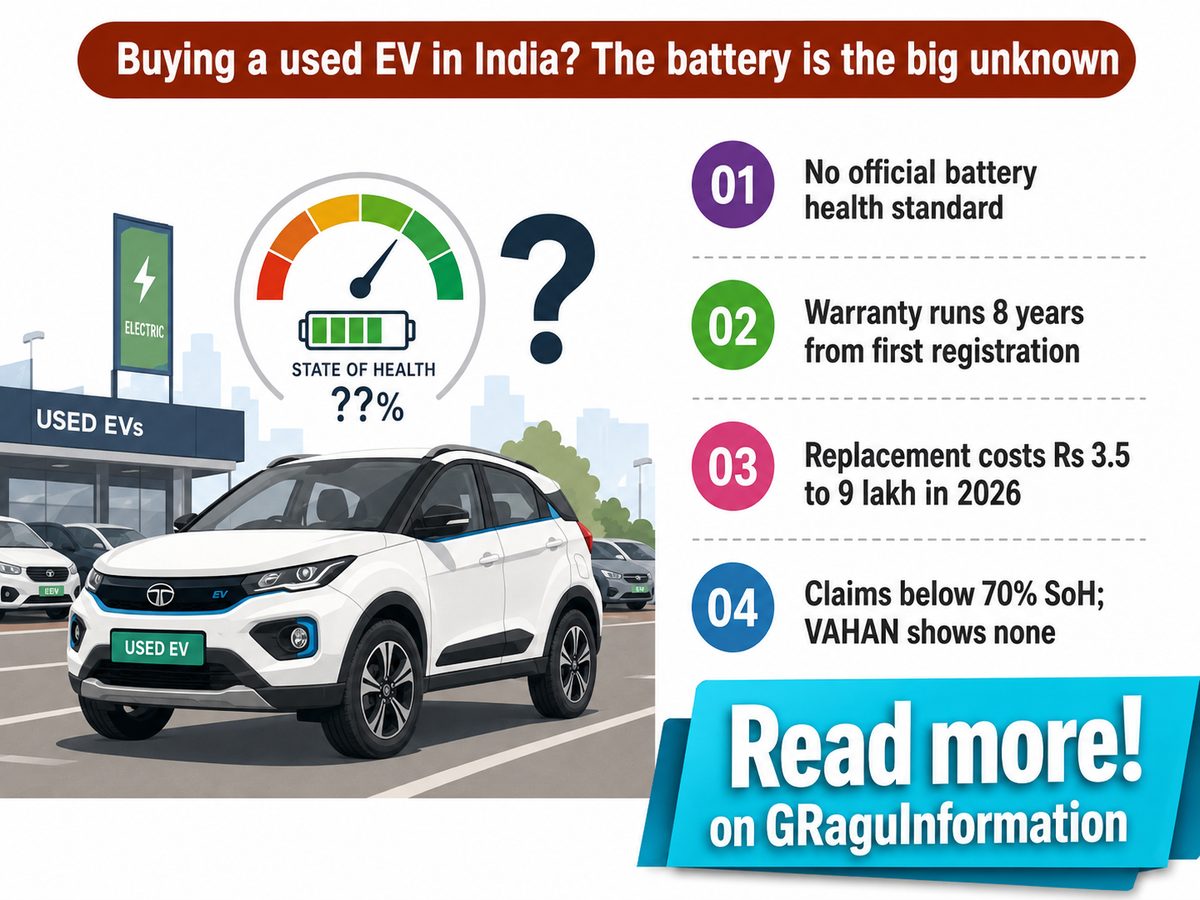
Four numbers frame the entire negotiation, and not one of them appears in a typical listing.
Warranty clock
8 years
Counted from first registration
Pack replacement
Rs 3.5 to 9 lakh
Nexon EV estimates, 2026
EVs registered
3.5 million
India, FY26, per SIAM
Battery share of cost
Up to 40%
Of the car's original price
The warranty clock is the one that catches people out. It starts on the day the first owner registered the car, not the day you take delivery, so every month they enjoyed is a month you never get. Buy deep into that window and you are really buying an out-of-warranty battery with a short grace period stapled on. Price it that way. The conversation gets honest fast.
A pack that costs more to replace than the car will fetch is not a repair job. It is a write-off with a service appointment attached.
What Actually Moves The Price
Sellers want to talk about range on a full charge. That number is mostly weather and driving style. The items below are checkable before money moves, and each one pushes the price in a direction you can defend out loud.
| Category | Detail | Insight |
|---|---|---|
| Claim floor | Tata pays a battery claim only below 70% State of Health | Slow fade above that stays yours |
| Distance cap | Tata 1,60,000 km, MG 1,20,000 to 1,50,000 km, Harrier.ev 2,00,000 km | Check the odometer against the brand cap |
| Transfer route | Tata and Hyundai move on the RC update; MG and Mahindra need a dealer request | Start the request before you pay |
| Transfer cost | Mahindra may charge Rs 500 to 1,500 plus a BMS health check | Budget it into the negotiation |
| First owner only | Tata's 15-year lifetime cover does not survive a sale | Resale reverts to the standard cover |
| Void triggers | Non-approved chargers or high voltage work outside the network | One void ends the whole battery cover |
| Insurance basis | IRDAI depreciation runs 5% at six months to 50% at four to five years | Written for engines, applied to packs |
| Paper check | Rs 49 for the RC check, Rs 49 for challans, Rs 79 for both | Cheapest hour in the whole purchase |
Read that middle column as one sentence: the loss is front-loaded and the protection is time-boxed. Skipping the cheap checks is exactly how buyers end up funding the expensive one.
Autocar India and Spinny's Mobility Intelligence Report 2026, built on more than 11,000 transactions across nine cities, puts used-car depreciation at 21% after one year, 33% after three and 41% after five, with a three-year-old car averaging Rs 8.38 lakh; the report also flags that EVs sit outside this curve because battery health has no agreed benchmark.
Friction Points
The advice you will hear everywhere is to ask for a battery health report. Sensible in the abstract, close to useless in practice today. That report comes from a diagnostic run by the same dealer setting the price, on a scale with no national definition, with no obligation to disclose how the reading was taken. Where I genuinely don't know the answer: whether any dealer-run readout can be trusted while the same dealer owns the margin on the sale. That is a stance, not a finding, and no rule currently forces the split.
Insurance is the second trap. Insurers still work off depreciation tables written for engines and gearboxes, so a total loss settlement can quietly ignore where most of an electric car's value actually sits. That mismatch will correct eventually, probably faster than the pricing side does, but until it does the buyer carries it. Anyone who followed the memory shortage behind phone price hikes will recognise the shape of it: the market reprices long before the paperwork catches up.
Before any money moves, get these in writing:
- Confirmation from the manufacturer, not the dealer, that the battery warranty survives the transfer, and on exactly what terms.
- The full in-network service history, with every gap explained rather than skipped past.
- The charging setup the first owner actually used at home, in writing from them.
- The odometer reading measured against that brand's own distance cap, which varies more than buyers expect.
Key takeaways before you pay
- Under GST 2.0 an EV sits at 5% with no compensation cess, part of why a used electric car's sticker looks kind to a first-time buyer.
- Get the brand's written transfer acknowledgement before handover. A dealer's verbal assurance exists nowhere on file when a claim is raised two years later.
- Have the State of Health diagnostic run inside the manufacturer's own service network, and keep the printout with the invoice and service book.
Treat a used EV as two purchases: a car, and a battery with a remaining term. If the seller cannot document the second one, walk away, or price the car as though the pack goes out of warranty tomorrow. Ask for the transfer confirmation in writing before you hand over the token amount, never after.
No comments
Post a Comment
Note: Only a member of this blog may post a comment.