Friday, October 23, 2026
AppleCare One Cost: $960 Over Four Years
The bill nobody plans for lands years after the purchase. An iPad bought five years ago cracks its screen, nothing covers it, and Apple's stated limit for adding a device to its newer plan is four years. So the AppleCare One cost is really two things: a monthly fee, and a clock that decides which of your devices can ever use it.
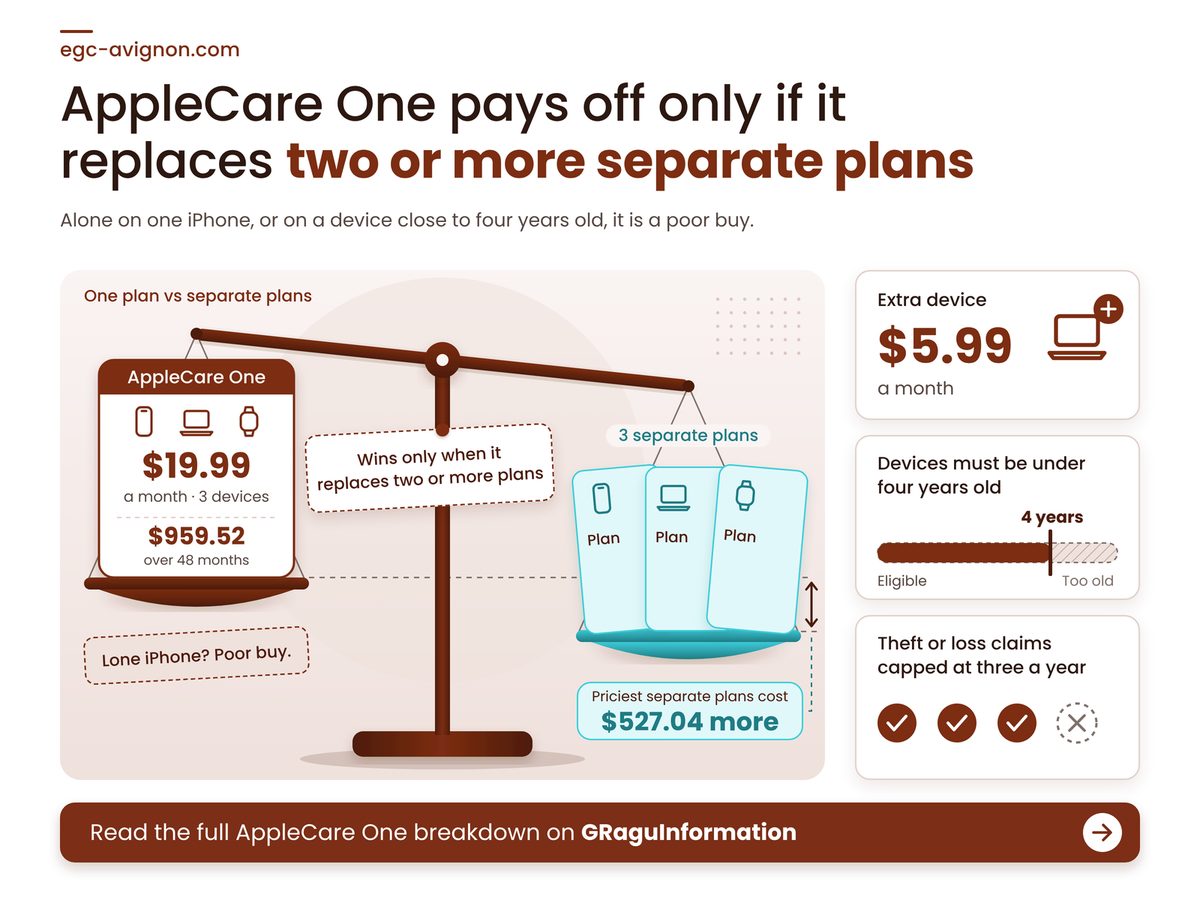
TL;DR: AppleCare One pays off when it replaces two or more separate plans, and it is a poor buy for a lone iPhone or any device close to four years old.
- Three devices cost $19.99 a month, about $960 over four years, before any claim fees.
- One iPhone on its own costs more here than on its own AppleCare+ with Theft and Loss.
- Claim fees and a yearly cap on loss claims sit on top of the monthly price.
- Check your oldest device's purchase date before anything else.
Why Does a Cancel-Anytime Plan Still Cost This Much?
Because the plan renews one month at a time and builds no equity, every month you stay costs the full fee, so the cost only stops when your need for coverage does. Apple's 23 July 2025 announcement priced AppleCare One at $19.99 a month for up to three products and $5.99 for each extra, and its disclosure calls it a recurring one-month term. Hold that fee for 48 months and it is the bill, money that comes back only if something breaks. The upside is the battery: replacement is included once capacity falls below 80%, which removes the out-of-warranty iPhone battery replacement fee.
Worked example: take an iPhone, an iPad and an Apple Watch kept for 48 months, ignoring claim fees and tax. Apple's AppleCare+ with Theft and Loss summary (September 2025 edition, the latest we could retrieve) lists monthly prices by model: iPhone $11.99 to $13.99, iPad $4.99 to $10.99, Watch $2.99 to $5.99. The cheapest trio adds up to $19.97 and the priciest to $30.97. Against the AppleCare One fee, the cheapest trio is a 2-cent monthly loss, while the priciest saves $527.04 over the four years, which squares with Apple's own claim of saving up to $11 a month. Your models decide which end you sit at, so price them first.
Four numbers settle whether the plan fits: how old your devices may be, what it costs over its life, how many losses it pays for, and how far it can undercut separate plans.
Age Ceiling For Adding A Device
4 years
Older gear cannot join the plan
Three Devices, 48 Months
$959.52
Derived: monthly fee times 48
Theft Or Loss Claims Allowed
3 a year
Fourth loss in a year is yours
Most You Could Save Monthly
$10.98
Priciest trio, derived above
The age ceiling applies when you add a device, so the date to check is each device's purchase date. Count back from today, 23 October 2026, to 23 October 2022: anything bought before that is already outside the limit Apple states. Age cuts the other way too, because Apple's vintage and obsolete lists decide how long repair parts exist, which is a different clock from this one.
Apple states the age limit for adding a device but, in the pages we read, never says what happens when a covered device turns four. Our view: plan for coverage ending there.
What Does AppleCare One Cost for Your Device Count?
Three devices cost about $240 in the first year and four times that over four years, and every extra device raises the bill, so find your device count below and read across.
Each cell is the monthly fee added up over that horizon, rounded to the dollar, before claim fees and tax. Find your row, then read across to how long you expect to keep paying.
| Your devices | 1 year | 2 years | 4 years |
|---|---|---|---|
| 1 to 3 devices | $240 | $480 | $960 |
| 4 devices | $312 | $624 | $1,247 |
| 5 devices | $384 | $767 | $1,535 |
| 6 devices | $456 | $911 | $1,822 |
The shaded cell is our base case. A fourth device lifts it by about 30%, stopping at two years halves it, and the first row shows the quiet trap: one device costs exactly what three do. Apple's Family plan, $49.99 a month for up to six people (apple.com/applecare, retrieved 23 October 2026), only undercuts adding devices one by one from the ninth device by our arithmetic, so its real draw is double the loss-claim allowance.
Fill all three included slots before paying for a fourth: each slot costs about $320 over four years whether or not it holds a device, and an extra device costs about $288. Derived from Apple's July 2025 monthly prices over 48 months, with the plan fee split three ways and rounded to the dollar.
What Are the Catches Before You Subscribe?
The catches are fees on accidental damage, a cap on loss claims, a device check you cannot preview, and a monthly term that stops paying out the day you stop paying.
Apple's AppleCare One disclosure sets the fees: $29 for an iPhone screen or back-glass claim, $99 for other accidental damage, and a $149 deductible for theft or loss. One $99 claim equals almost five months of the plan fee, so two or three of them add roughly a fifth to a third on top of the base cost. Eligibility is the second catch. Apple's support article, published 14 September 2026, says some devices will not be eligible and will not be visible before you subscribe, so you learn that your oldest device is out only after you sign up.
Outside the US the numbers differ: Apple UK lists £16.99 a month for three products and £4.99 per extra (27 July 2026), or £815.52 over 48 months. And treat it like any subscription. The five-year iCloud arithmetic shows why a small monthly fee deserves a yearly review.
- Start the plan within 60 days of buying a device, the window Apple's support article gives; later additions may face a device check.
- File a claim within 60 days of the incident, the deadline in Apple's disclosure.
- Battery cover starts only below 80% capacity, so a battery at 85% is still your cost.
Four conditions to check on your own devices
- Every device you want covered is signed in to your Apple Account, the only place Apple lists them.
- None sits on an iPhone Upgrade Program plan, which Apple Support must cancel before AppleCare One can take over.
- You are inside 60 days of buying each new device, or you accept a device check.
- You could pay a loss deductible from savings, not credit.
This week, list every Apple device you own with its purchase date, price each one's own AppleCare+ plan on Apple's site, and subscribe only if those prices total more than $19.99 and every device you add is inside the age limit. Skip it if your separate prices come in lower. That advice is wrong for a device that would otherwise go uncovered entirely, because then you are weighing the plan against a repair bill, and Apple's AppleCare One support page is where you check what your own devices qualify for.
How we checked this
We read Apple's AppleCare One announcement (23 July 2025), its AppleCare One summary (July 2025), its AppleCare+ summary (September 2025) and its support article (14 September 2026). The worked example assumes an iPhone, iPad and Watch at the lowest and highest listed prices for 48 months. No product was tested hands-on for this article. Last verified: 23 October 2026. Edited by G Ragu, reviewed after publication. Spotted something out of date? Tell us and we will correct it.