Wednesday, November 11, 2026

iPhone Trade-In Value: $799 Becomes $175

Nobody budgets for the last line of an iPhone's bill. It arrives five years after the purchase, when the phone still works, the battery is tired, and Apple offers a fraction of what you paid. For a base iPhone 13 that fraction is $175 against an $799 launch price. That gap is the iPhone trade-in value problem in one subtraction, and it decides whether keeping a phone is the cheap choice or only the quiet one.
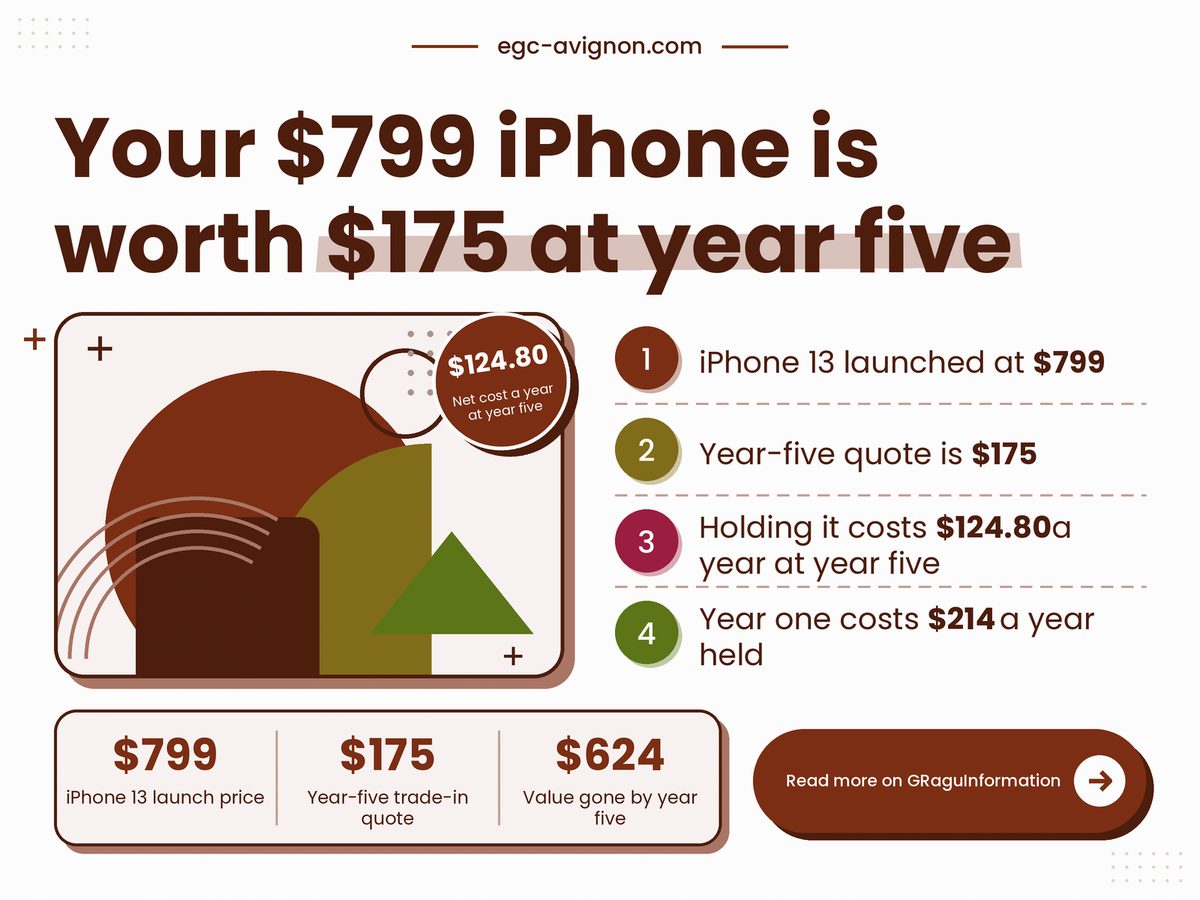
iPhone trade-in value falls from $799 at launch to a $175 quote at year five for an iPhone 13

Keep a base iPhone for five years and it costs about $125 a year after trade-in; trade it at year one and it costs $214.

  • Apple's list is a ceiling: a condition check can revise it down by half or more.
  • Quotes moved 17% in five weeks on an unchanged iPhone 14, so timing matters.
  • Year four to year five gives up the least value of any step on the ladder.
  • Run the sum with your own model and price before you order.

Why iPhone trade-in value drops 27% in year one

Apple's September 2026 list pays up to $585 for a one-year-old iPhone 17, 73% of its $799 launch price, so the steepest loss lands in year one and the curve flattens after.

The list figures are as MacRumors reported Apple's table on 15 September 2026. The launch side is Apple's own: its releases for the iPhone 12 (64GB, October 2020), 13, 14, 15 and 16 (all 128GB) each state $799, and the iPhone 17 holds that price while moving to 256GB. Quotes also vary by configuration, so the choice in iCloud storage cost against a bigger iPhone shapes what comes back.

Assume each phone was bought at launch and held to September 2026. Launch price minus list value, divided by years held, runs $214 for the 17, then $185, $165, $151, $125 and $113 for the iPhone 12 at year six. That is my own arithmetic, not an Apple figure: keeping from year one to year five saves about $89 a year.

Waiting has its own price: each step down a model costs $155, $125, $110, $20, then $55 of list value. Year four to five is the cheapest step, though a proxy that compares two models, not one phone aging. Keeping also has a running cost, priced in iPhone battery replacement cost after warranty.

Timing moves the quote too. The iPhone 16 listed at $410 on 15 January 2026, $480 on 6 August (9to5Mac) and $430 on 15 September, with the phone unchanged. Pro models fell harder on the last date: the 16 Pro lost 19%, against 10% for the base 16. August was the best month this year, but one year is a pattern, not a rule.

Four figures decide the choice: a year's cost, a quote's lifespan, the price already gone and the swing a quote can take.

Net Cost, Year One

$214

Highest yearly cost, newest phone

Quote Lifespan

14 days

After the new phone arrives

Gone By Year Five

$624

Derived: launch price minus list

One-Month Swing

17%

Unchanged iPhone 14, quote drop

The shelf life runs from the day the replacement is in your hands. Price the old phone, order the new one, then ship the old one before the quote lapses, or you are re-quoted at that week's list.

"

Apple's list moved 17% on an unchanged iPhone 14 in five weeks. The quote is a price Apple sets, not a measurement of your phone.

What does each year of keeping an iPhone cost?

Each extra year held lowers a base iPhone's yearly cost, from $214 in year one to $125 in year five at Apple's full list value, and the grid below shows how a condition cut changes that.

Find your row, read across at the cut Apple might apply. The cuts are 20% (our wear assumption) and 60% (about the size of two forum-reported revisions); cells are dollars a year, rounded.

Phone, ageListed-20%-60%
17 at 1 yr$214$331$565
16 at 2 yrs$185$228$314
15 at 3 yrs$165$185$226
14 at 4 yrs$151$161$180
13 at 5 yrs$125$132$146

The bold cell is the base case. One row up adds $26 a year; one column right adds $7. The right-hand column carries the lesson: a 60% cut costs a one-year-old 17 $351 a year more, but a five-year-old 13 only $21.

iPhone 17 year 1, $585 73% kept iPhone 16 year 2, $430 54% kept iPhone 15 year 3, $305 38% kept iPhone 14 year 4, $195 24% kept iPhone 13 year 5, $175 22% kept iPhone 12 year 6, $120 15% kept

Which phones are still worth waiting on? Each icon fills to the share of launch price the list returns, and after year four the fill barely moves. Derived from the 15 September 2026 list against Apple's launch prices.

Worked example: take an iPhone 13 bought at launch for $799 and held five years to September 2026. Assume the list value of $175 holds and no condition cut applies. Net cost is $799 minus $175, or $624; divided by 5 years, that is $124.80 a year. Your own version takes a minute: what you paid, minus today's quote for your model on Apple's trade-in page, divided by the years you have held it.

What does your iPhone cost per year held?Enter what you paid, the years you kept it and Apple's quote for your model. Add a condition cut to see a revised value.
Your numbers
You get back$175
Value lost$624
Net cost per year held$124.80
Share of price kept22%
At the full quote you get back $175, and the phone costs $124.80 a year held. A condition cut raises that.Sliders need JavaScript. Figures shown are the article's example.Quote values are Apple Trade In up-to figures as reported by MacRumors on 15 September 2026; cost per year is price paid minus value received, divided by years kept.

Why did Apple lower my trade-in value after I shipped it?

Apple's quote assumes the condition you described and Apple checks it when the device arrives, so where the check disagrees it issues a revised value that you may accept or reject, per its terms as of November 2026.

An iPhone 15 Pro Max owner on Apple's support forum wrote in October 2024 that a $650 quote became $250 after mailing, with Apple saying it had received an iPhone 13; a second poster described a $520 quote cut to $220. An older MacRumors Forums thread reports an iPhone 12 Pro quoted $790 and revised to $310 over claimed display faults. These are anonymous reports, not statistics, and Apple's side is not shown.

Our call: treat a mailed trade-in as a sale you may have to dispute. Replies in the older thread advise trading in at a store, which is user advice, not an Apple promise. A phone near the repair cut-off in Apple's vintage and obsolete lists is also one to retire on your schedule.

  • Photograph both sides with the screen lit, and keep the packing receipt and serial number.
  • Apple's own engraving does not lower the value; third-party engraving may, per its trade-in page.
  • Credit goes to your original payment method up to the purchase price; any excess arrives as an Apple Gift Card.

Check these before you trade

  • Your phone is a base model past year four and still works.
  • Your quote used the storage size and condition you can prove today.
  • You will dispute a revised value, or can hand the phone over in a store.
  • The replacement costs more than the quote, so the credit has somewhere to go.

This week, open Apple's trade-in page, enter your model, and run the sum above with your own price; trade only if another year of waiting would give up more value than the upgrade is worth to you, and keep the phone otherwise. The advice flips if your phone is failing or close to losing repairs, so check that first, then price the rest of the bill in AppleCare One cost over four years.

How we checked this

We read Apple's trade-in page on 11 November 2026 and three list reports: MacRumors, 15 September 2026, 9to5Mac, 6 August 2026 and MacRumors, 15 January 2026. The worked example assumes a launch-day $799 purchase and an unreduced list value; the 20% and 60% columns are our assumptions. No product was tested hands-on for this article, and list values are "up to" figures, not offers.

Last verified: 11 November 2026

Edited by G Ragu, reviewed after publication. Spotted something out of date? Tell us and we will correct it.
Wednesday, November 4, 2026

Apple One Price Increase Adds $60 a Year

A new iPhone brings three free months of Apple One, and the bill that follows arrives at the highest price yet. Most of us never revisit a plan once it is running, which is why the apple one price increase of 2026 deserves a second look: it came in two steps, it reached every tier, and it lands on the first full invoice. Apple's own page now lists the cheapest tier at $21.95 a month.

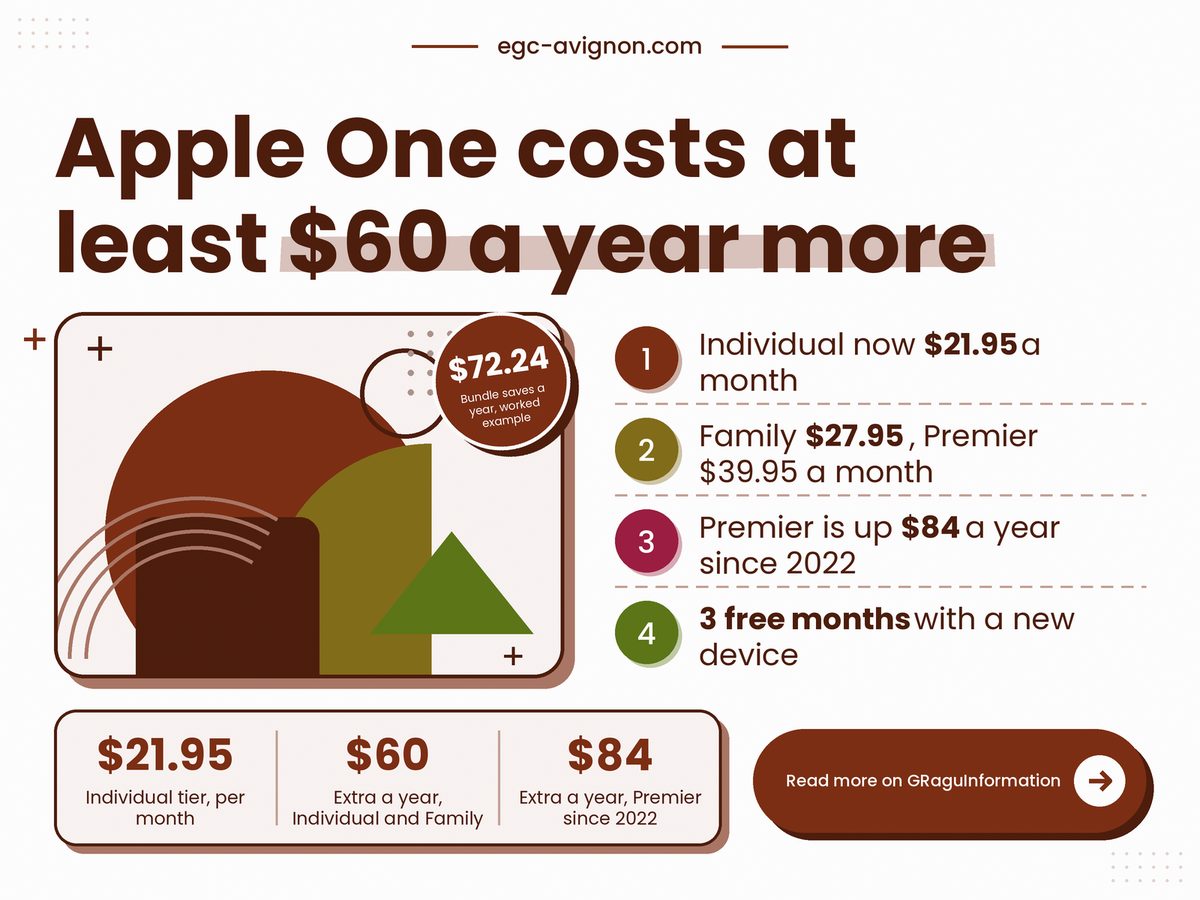
Apple One price increase poster: Individual tier now $21.95 a month, up at least $60 a year since 2022

Every Apple One tier now costs at least $60 a year more than in October 2022, so keep the bundle only if your separate subscriptions would cost more.

  • Premier took the biggest rise, $84 a year; the other two tiers rose $60 each.
  • Apple TV plus Music is the mix that clearly beats Individual.
  • Cancelling needs no contract, only notice a day before the renewal date.

What did the Apple One price increase change in 2026?

Apple raised Apple One twice in 2026: Family and Premier gained $2 a month each on 17 July, and Individual gained $2 on 28 August, leaving all three tiers at their highest list prices.

MacDailyNews reported the July step and 9to5Mac the August one. The parts rose too: Apple Music Family went up $3 a month in July and Apple TV $2 in August, so the gap between bundle and parts matters more than either price.

No source lists the tiers side by side, so the timeline below does, using the earlier prices in AppleInsider's October 2023 report. Against Apple's page today, the lower two tiers cost $60 a year more than in 2022 and Premier $84 more (our sums: the monthly rise times twelve). On a four-year phone that is $240 extra on Individual, close to a year of the plan for nothing new. Apple's other recurring charge behaves alike: see our AppleCare One cost over four years.

Free months are a loan, or maybe a sample. Will the steps stop? Three in under three years make a flat price the less likely bet, though that is opinion, not forecast. The old line that Apple One is a no-brainer has aged badly: storage alone rarely justifies it (see our iCloud storage cost against a bigger iPhone post), so the case rests on TV and Music together.

Four numbers decide whether the bundle still earns its slot. Apple's own Apple One page, read on 4 November 2026, supplies the tiers and terms; the rises are our arithmetic from the trade reports.

Individual Bill, One Year

$263.40

$60 above the 2022 level

Free With A New Device

3 months

One offer per family, then full price

Premier Rise Since 2022

21.2%

Derived: $7 more every month

Services In Premier

6 services

Shared with up to five people

The free period works once. Apple's page says the offer is unavailable if you or your family have accepted an Apple One three-months-free offer before, so the first full bill is the real price.

"

Our call: judge Apple One by its first full bill, not its free months. The trial costs nothing, so it never shows you what the plan has climbed to.

Is Apple One worth it at today's prices?

Apple One is worth it only when the services you would otherwise pay for separately add up to more than the tier price, and for anyone paying for just one service they do not.

Worked example: take one person on Individual who would otherwise pay for Apple TV and Apple Music Individual, plus the 50GB iCloud+ plan. Bought direct, that is $14.99 + $11.99 + $0.99 = $27.97 a month, as of November 2026, from Apple's TV and Music pages and its iCloud+ price list (published 16 September 2026). The tier is $21.95, so the bundle saves $6.02 a month, or $72.24 over twelve months. Assumptions: one person, no Arcade, and 50GB is all the storage you need.

Does Apple One beat paying separately?Pick your tier and switch on each service you would otherwise pay for. Premier counts Fitness+ and News+ as yours. A minus sign means the bundle costs more.
Your numbers
Apple One tier
Separate, per year$335.64
Apple One, per year$263.40
Bundle saves a year$72.24
Apple One saves you $72.24 a year on these services, so keep it.Sliders need JavaScript. Figures shown are the article's example.US prices from Apple's own service and iCloud+ pages as of November 2026; Music Family applies to Family and Premier; the iCloud+ switch uses the size each tier includes.

Now run the check with your own numbers, in under a minute: add the Apple lines on your last card statement and subtract the tier price. Each table row below counts the iCloud+ size its tier includes.

Your situationBest moveMonthly gap
TV and MusicKeep IndividualSaves $6.02 a month
Music onlyCancel, buy Music directBundle costs $8.97 more
TV onlyCancel, buy TV directBundle costs $5.97 more
Family of fiveKeep FamilySaves $10.02 on TV and Music
Trial endingSet a cancel dateNotice due a day before renewal

Read down the last column: single-service households overpay, and anyone buying TV and Music direct gains. An enthusiast-forum poster on MacRumors wrote in August 2026 that they were "getting my money's worth out of the premium plan" so far.

Oct 2022 Oct 2023 Jul 2026 Aug 2026 Individual $16.95 start $19.95 +$3 $19.95 same $21.95 +$2 Family $22.95 start $25.95 +$3 $27.95 +$2 $27.95 same Premier $32.95 start $37.95 +$5 $39.95 +$2 $39.95 same

Read across your row to see how far your tier has climbed since October 2022 before deciding whether to keep it: the lower two tiers gained $5 a month and Premier $7. Prices come from AppleInsider (2022 and 2023), MacDailyNews and 9to5Mac (2026); the monthly gains are our arithmetic.

Where the bundle quietly costs more than it should

The bundle costs more than it should when you still pay for services separately during the switch, or when you hold a tier bigger than your household uses.

The first trap is overlap. Apple's page says the free month covers only subscriptions you do not already have, and that services you already pay for keep billing separately until you switch to an Apple One plan.

The second is timing. MacDailyNews says existing subscribers see the July step at their next billing cycle, and 9to5Mac says Individual holders are told about a month ahead, so the notice email is your window. Two posters on the same MacRumors thread (August 2026) described leaving: one drew the line at "raising Apple One above $20/mo" and named a Google student bundle as the swap, the other moved to library and streaming substitutes without saying they missed it. Single voices, not a trend. Hardware shows the same deferred-bill pattern: see our iPhone battery replacement cost post.

  • Family Sharing does not start by itself; Apple's page says you set it up.
  • TV and Arcade already share with your family on Individual.
  • Premier costs $12 a month above Family; without Fitness+ or News+, that buys only 2TB.

Downgrade or cancel if any of these is true

  • Your Apple lines on the last card statement come to less than your tier.
  • You pay for Family but the household only shares TV or Arcade.
  • You pay for Premier and have opened neither Fitness+ nor News+ since July.

The decision: keep Apple One or buy direct. This week, open your Apple Account's subscriptions list and add up every Apple line you pay for. Below your tier, downgrade or cancel at least a day before renewal; above it, keep the bundle. The advice flips if you need more storage than your tier includes, so check that first.

How we checked this

Checked: Apple's Apple One page (4 November 2026), MacDailyNews (17 July 2026), 9to5Mac (28 August 2026) and AppleInsider (October 2023). Derived: the worked example assumes one person on Individual with TV, Music and 50GB storage. Not done: no product was tested hands-on, and the Wayback Machine held no 2023 copy of Apple's page, so earlier prices rest on trade reports. Last verified: 4 November 2026. Edited by G Ragu, reviewed after publication. Spotted something out of date? Tell us and we will correct it.